

How does the surface charge affect the anti - fouling property of alumina ceramic membrane?
Jan 19, 2026
Leave a message
As a supplier of alumina ceramic membranes, I've witnessed firsthand the growing demand for high - performance filtration solutions across various industries. The anti - fouling property of alumina ceramic membranes is a crucial factor that significantly impacts their performance and longevity. In this blog, I'll delve into how surface charge affects the anti - fouling property of these membranes.
Understanding Alumina Ceramic Membranes
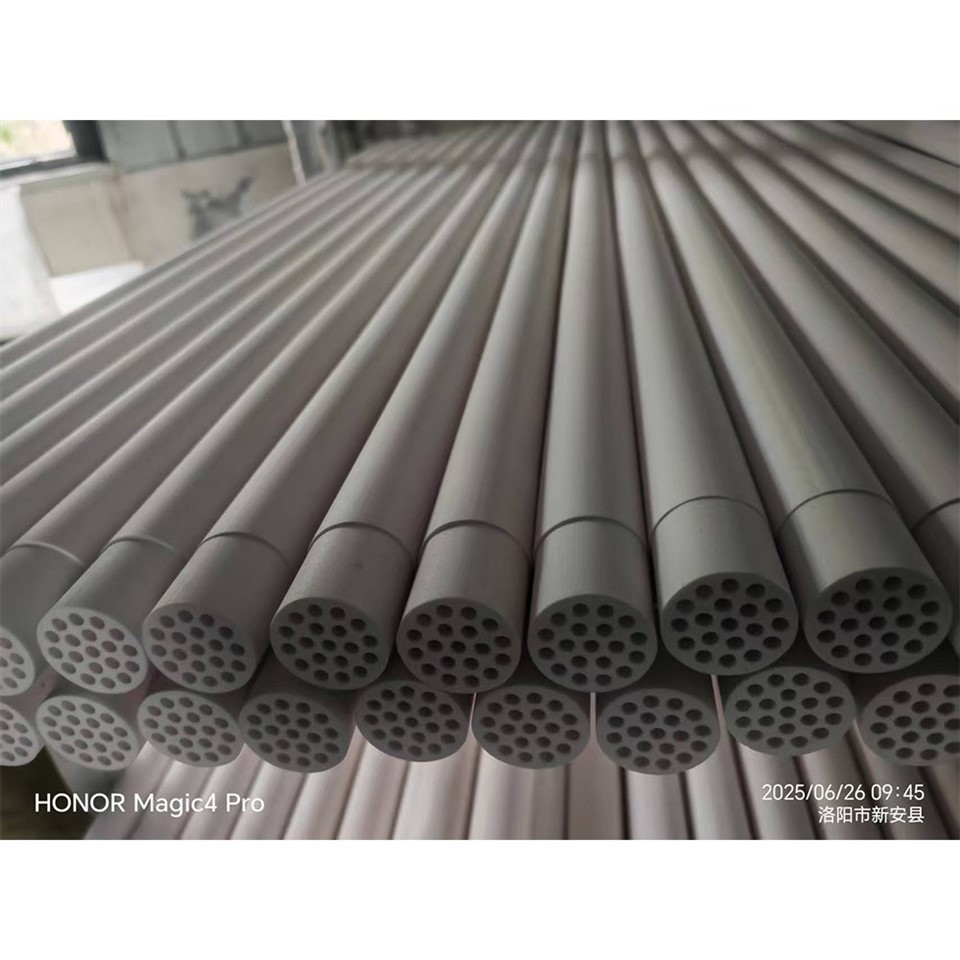
Alumina ceramic membranes are widely used in separation processes due to their excellent chemical stability, high mechanical strength, and good thermal resistance. They come in different configurations, such as Alumina Ceramic Flat Membrane and Alumina Ceramic Tubular Membrane, which are suitable for different applications.
These membranes are porous materials, and their separation mechanism is based on the size exclusion principle. However, fouling is a common problem that can reduce the membrane's permeability and separation efficiency over time. Fouling occurs when particles, colloids, macromolecules, or microorganisms accumulate on the membrane surface or within its pores, forming a layer that restricts the flow of the filtrate.
The Concept of Surface Charge
The surface of an alumina ceramic membrane has a net electrical charge, which is determined by the dissociation of surface functional groups and the adsorption of ions from the surrounding solution. In an aqueous environment, the surface hydroxyl groups ($-OH$) of alumina can either donate or accept protons ($H^+$), depending on the pH of the solution.
At low pH values, the surface of the alumina membrane becomes positively charged as the hydroxyl groups accept protons:
[Al - OH + H^+\rightleftharpoons Al - OH_2^+]
At high pH values, the surface becomes negatively charged as the hydroxyl groups donate protons:
[Al - OH\rightleftharpoons Al - O^-+H^+]
The pH at which the net surface charge of the membrane is zero is called the isoelectric point (IEP). For alumina, the IEP typically ranges from 7 - 9. When the solution pH is below the IEP, the membrane surface is positively charged, and when the pH is above the IEP, the surface is negatively charged.
Influence of Surface Charge on Anti - Fouling Property
Electrostatic Repulsion
One of the primary ways surface charge affects the anti - fouling property is through electrostatic repulsion. Most foulants, such as colloidal particles and macromolecules, also carry an electrical charge in solution. If the surface charge of the membrane has the same sign as the charge of the foulants, electrostatic repulsion will occur.
For example, in a water treatment process where the foulants are negatively charged colloids, using an alumina ceramic membrane with a negative surface charge (by adjusting the pH above the IEP) can prevent the foulants from approaching the membrane surface. This repulsion force acts as a barrier, reducing the deposition of foulants on the membrane and thus improving its anti - fouling property.
Conversely, if the membrane surface has an opposite charge to the foulants, electrostatic attraction will occur, leading to increased fouling. For instance, if positively charged proteins are present in a solution and the membrane surface is negatively charged, the proteins will be attracted to the membrane, causing rapid fouling.
Interaction with the Electric Double Layer
The surface charge of the membrane also affects the structure of the electric double layer (EDL) at the membrane - solution interface. The EDL consists of a layer of charged ions adsorbed on the membrane surface (Stern layer) and a diffuse layer of counter - ions in the solution.
When the membrane surface charge is high, the EDL is more extended, and the repulsive forces between the membrane and the foulants are stronger. This can prevent the foulants from penetrating the EDL and reaching the membrane surface. On the other hand, a low surface charge results in a thinner EDL, and the foulants can more easily approach the membrane and cause fouling.
Impact on Hydrophilicity and Surface Energy
Surface charge can also influence the hydrophilicity and surface energy of the alumina ceramic membrane. A charged surface can interact with water molecules more strongly, increasing the hydrophilicity of the membrane. Hydrophilic membranes are generally more resistant to fouling because they can form a hydration layer on the surface.

The hydration layer acts as a physical barrier, preventing the direct contact between the foulants and the membrane surface. Additionally, a hydrophilic surface has a lower surface energy, which reduces the adhesion of hydrophobic foulants such as oils and fats. By adjusting the surface charge, we can optimize the hydrophilicity of the membrane and enhance its anti - fouling performance.
Controlling Surface Charge for Improved Anti - Fouling
As a supplier of alumina ceramic membranes, we have several methods to control the surface charge of the membranes to improve their anti - fouling properties.
pH Adjustment
One of the simplest ways to control the surface charge is by adjusting the pH of the feed solution. By carefully selecting the pH based on the IEP of the membrane and the charge of the foulants, we can ensure that the membrane surface and the foulants have the same charge, thereby maximizing electrostatic repulsion.
Surface Modification
Another approach is surface modification. We can modify the surface of the alumina ceramic membrane by grafting functional groups or coating it with a charged polymer. For example, coating the membrane with a positively charged polymer can make the membrane surface positively charged, which is useful for repelling negatively charged foulants.
Ion Exchange
Ion exchange can also be used to control the surface charge. By introducing specific ions into the solution, we can change the ion - adsorption behavior on the membrane surface and thus alter the surface charge. For example, adding cations such as calcium or magnesium ions can increase the positive surface charge of the membrane under certain conditions.
Case Studies and Applications
Let's look at some real - world applications to illustrate the importance of surface charge in improving the anti - fouling property of alumina ceramic membranes.
Water Treatment
In water treatment plants, alumina ceramic membranes are used to remove suspended solids, bacteria, and other contaminants from water. By adjusting the pH of the feed water to ensure that the membrane surface and the foulants have the same charge, we can significantly reduce fouling. This results in a higher membrane flux, longer operation time between cleanings, and lower operating costs.
Food and Beverage Industry
In the food and beverage industry, alumina ceramic membranes are used for processes such as juice clarification and milk concentration. The foulants in these applications are often proteins, polysaccharides, and fats. By controlling the surface charge of the membrane, we can prevent the deposition of these foulants and maintain the high performance of the membrane during long - term operation.
Conclusion
The surface charge of alumina ceramic membranes plays a crucial role in determining their anti - fouling property. Through electrostatic repulsion, interaction with the electric double layer, and influence on hydrophilicity, surface charge can either promote or prevent fouling. As a supplier of alumina ceramic membranes, we are committed to providing our customers with membranes that have optimized surface charges for their specific applications.
If you are interested in our alumina ceramic membranes and want to discuss how we can tailor the surface charge to meet your anti - fouling requirements, please feel free to contact us for a procurement discussion. We look forward to working with you to solve your filtration challenges.
References
- Kiso, Y., & Yamaguchi, T. (2005). Charge Characteristics of Porous Alumina in Aqueous Solutions. Journal of Chemical Engineering of Japan, 38(12), 1113 - 1118.
- Vrijenhoek, E. M., Hong, S. - H., & Elimelech, M. (2001). Molecular weight cutoff and surface charge effects on protein fouling of nanofiltration membranes. Journal of Membrane Science, 188(2), 115 - 128.
- Yang, F., & Zhang, X. (2012). Surface charge modification of ceramic membrane and its application in water treatment. Desalination, 301(0), 153 - 159.